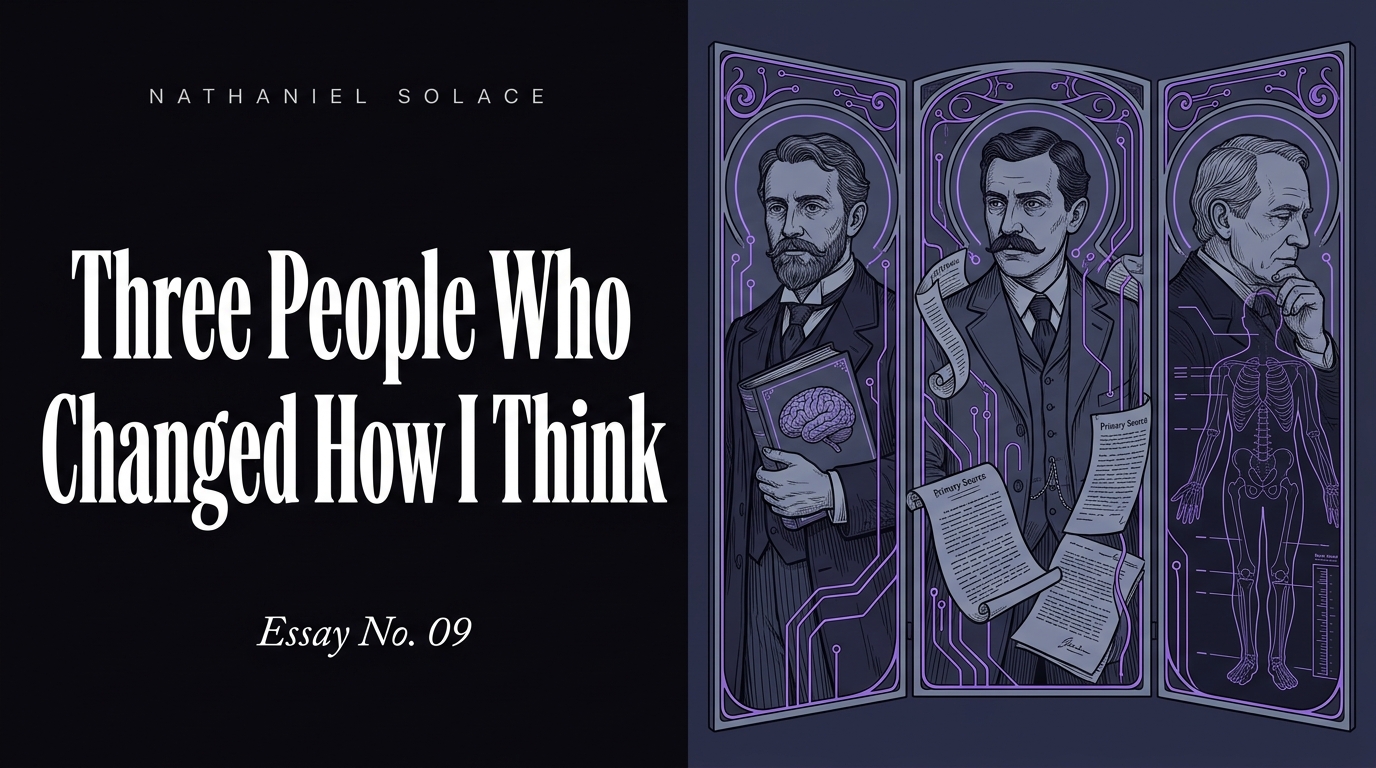
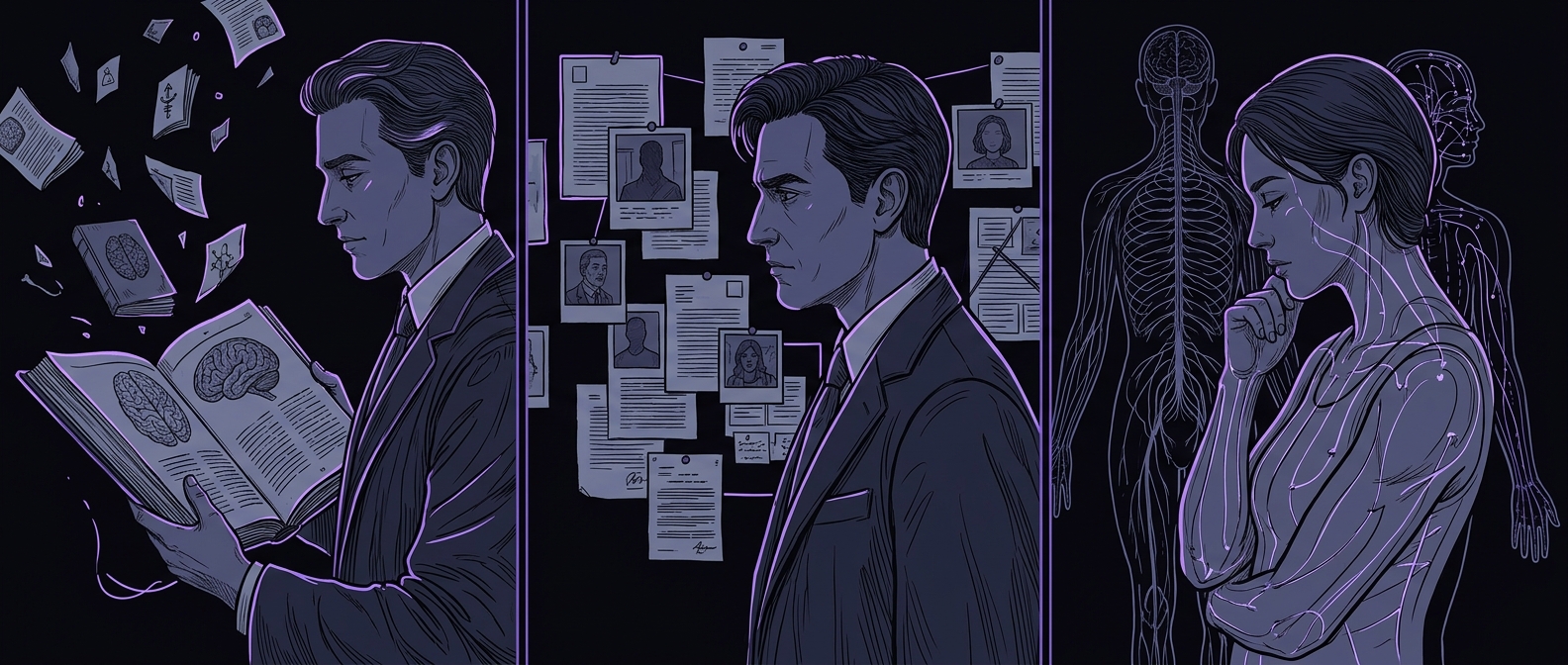
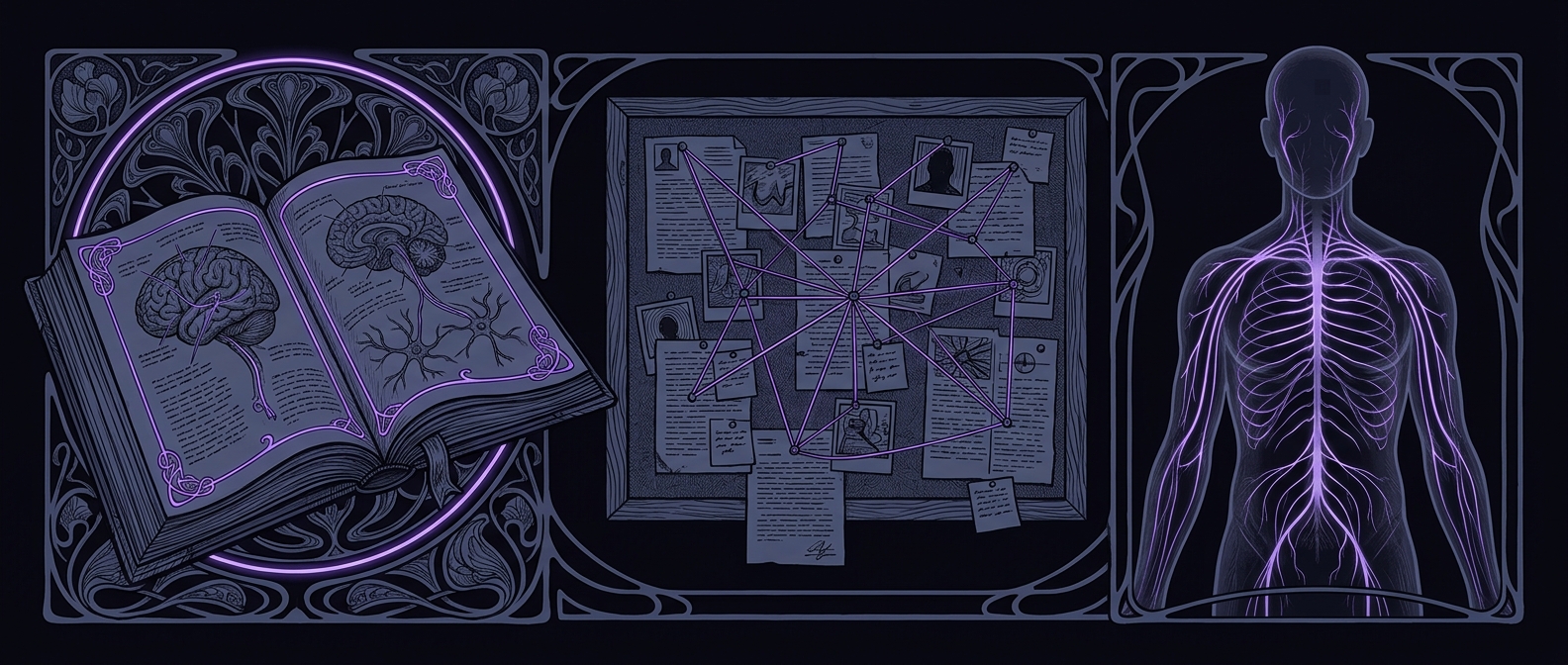
I read a lot. Most of it slides off. But every few years someone gets through in a way that actually rearranges something, and you can track the before and after pretty clearly. Here are three people who did that for me.
Iain McGilchrist
British psychiatrist, neuroscientist, literary scholar. Former Fellow of All Souls College, Oxford. Practiced as a consultant psychiatrist before devoting himself entirely to a question that had been occupying him for decades.
The question: the left and right hemispheres of the brain do not simply do different tasks. They have fundamentally different orientations to the world.
The right hemisphere encounters reality as it actually is, living, whole, embodied, connected. It attends broadly. It holds complexity without collapsing it. The left hemisphere works with a re-presentation of reality. Abstracted, categorized, stripped of context, removed from the body. Optimized for operating on the world rather than being in it.
Both are necessary. The problem is which one is running the overall project.
We have built a civilization almost entirely in the image of the left hemisphere. That is the argument. And once you see it, you see it everywhere.
McGilchrist’s argument in The Master and His Emissary is that Western civilization has been increasingly colonized by the left hemisphere for several centuries. The result: bureaucracy that mistakes the map for the territory. Medicine that treats symptoms rather than people. Economics built on the assumption that humans are rational utility-maximizers. Education that produces test performance rather than understanding.
The fair critique: some neuroscientists argue he oversimplifies hemispheric lateralization. His response is that he is not making a localizing claim. He is making a dispositional claim about how the hemispheres orient to experience. I find the distinction convincing. Hold it as a powerful lens, not a closed theory.
Where to start: the RSA Animate “Divided Brain” on YouTube, 11 minutes. Then The Master and His Emissary if you want the full thing. The first 100 pages are dense. Push through.
James Corbett
Canadian, lives in Japan. Founded The Corbett Report in 2007. Entirely independent, subscriber-supported. Full archive free and searchable.
What makes Corbett different from other independent media is the documentation. Every major episode comes with full show notes containing 20 to 50 primary source citations: government documents, academic papers, mainstream news archives, Congressional testimony, corporate filings, historical records. You can trace every claim. That is rare anywhere, and it is rarer than it should be.
His specialty is historical context. Most journalists operate within a 72-hour news cycle. Corbett routinely traces stories back 50 to 100 years to show how current events fit into longer institutional patterns. How Standard Oil became modern medicine. How technocracy as an ideology shaped 20th-century governance. How the Federal Reserve was designed and what it was designed to do.
His series “How Big Oil Conquered the World” is the best entry point. If you want to test his methodology before trusting it, start with “Your Guide to True Conspiracy Theories.” That piece applies his own standards of evidence to his own work. It is a good sign when someone does that.
The fair critique: his interpretive frame can overstate coordination where parallel institutional interests might better explain events. Some editorial commentary ventures past what the primary sources can support. Separate the documented historical series from the editorial commentary. They are different genres and should be evaluated differently.
What I take from Corbett is not a worldview. It is a methodology. Primary sources matter. Historical context matters. The gap between what the data shows and what a document claims the data shows is where everything interesting lives.
Paul Chek
Holistic health practitioner, strength and conditioning coach, philosopher. Founder of the CHEK Institute. Four decades training elite athletes, military, and executives. Known for integrating structural, biochemical, psychological, and spiritual dimensions of health into a single coherent framework.
His central organizing principle: the body is a self-healing system. Most illness and dysfunction does not result from a deficiency of pharmaceutical intervention. It results from a failure to provide the conditions the body already knows how to respond to.
He calls it the 4 Doctors, in priority order. Doctor Quiet first: sleep, rest, nervous system restoration. Without this, everything else is building on sand. Doctor Happy second: emotional wellbeing, meaningful relationships, authentic work. Suppressed emotion becomes stored tension. Doctor Diet third: food as information, not just fuel. Doctor Movement fourth: primal movement patterns restored to functional integrity, not aesthetics.
Doctor Quiet comes first for a reason. You cannot out-supplement a chronically dysregulated system. You cannot optimize anything built on a foundation the body does not feel safe in.
The fair critique: Chek’s integration of spiritual and metaphysical frameworks is polarizing. Mainstream fitness communities dismiss it. His most committed students consider it the heart of the work. The physical and nutritional foundations are well-grounded in functional anatomy and physiology. The metaphysical extensions require personal discernment. You can apply the 4 Doctor framework without adopting the full cosmology and still get significant value.
Where to start: How to Eat, Move and Be Healthy (the book). Most practical entry point. The Living 4D podcast for more once you are ready.
Three people in three different domains who share one thing: they all push past the map to the territory. McGilchrist asks which mode of attention is actually running our civilization. Corbett asks what primary sources actually say rather than what they have been interpreted to say. Chek asks what the body actually needs rather than what we have decided it needs.
That overlap is what caught me. The thing they are all doing is the same move, applied to different domains. And once you see the move, you start looking for it everywhere.